Continuous Engineering Press
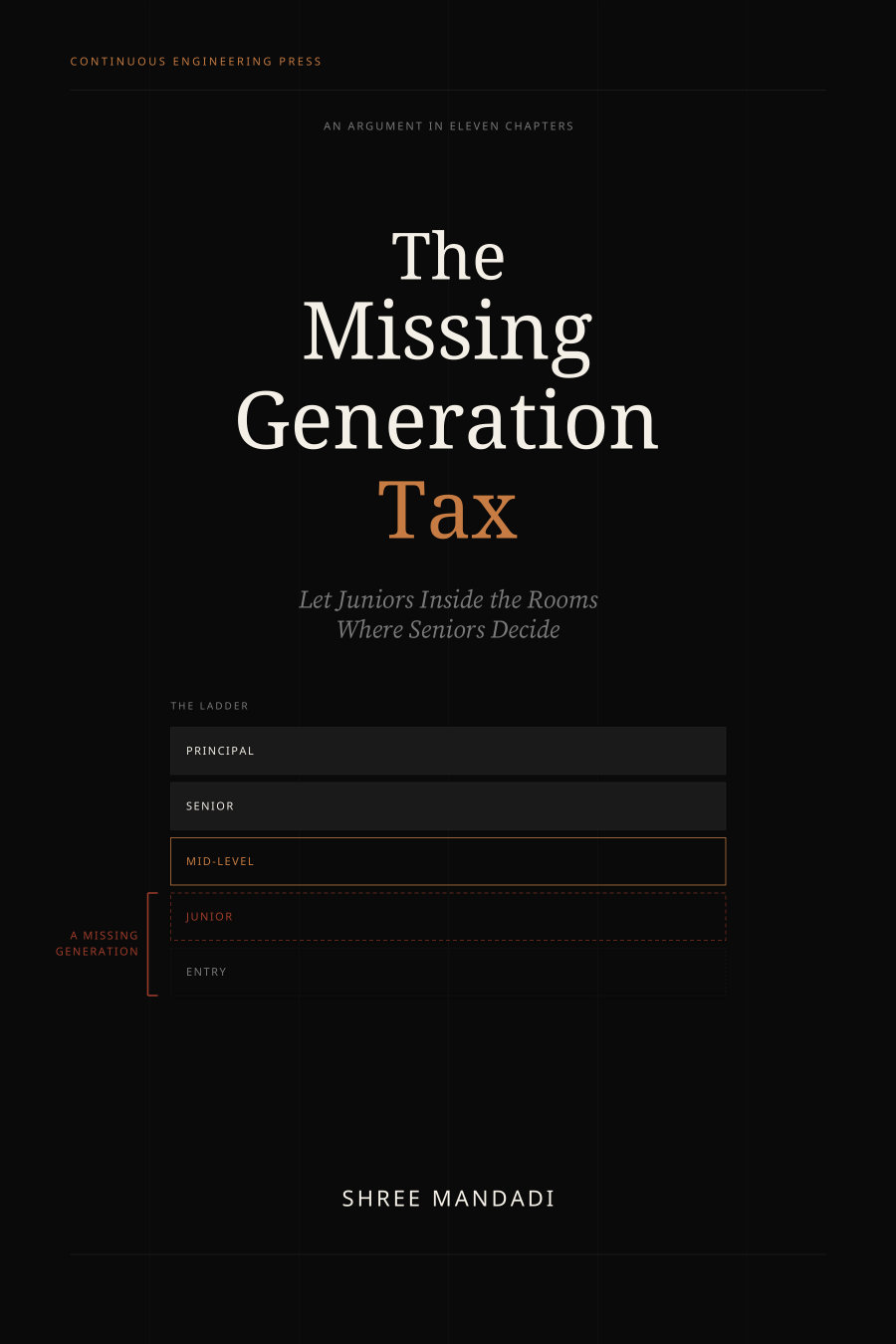
The Missing Generation Tax
Let Juniors Inside the Rooms Where Seniors Decide
Sold on Amazon. This site does not sell the book.
“In 2035, who will you promote?”
About the book
AI now does the work that used to grow juniors into seniors, and does it faster and cheaper. Each team that skips the junior hire is making a sound call for the quarter. Add those calls up and a generation of senior people never forms. Nothing on the books shows it until the day you need one.
Related: The Missing Generation Manifesto. It is published on continuous.engineering, the author's site.
Inside the book
What it covers
The Missing Generation Tax names that cost, measures it, and shows you how to pay it on purpose, as a budget line funded from what AI saves you.
Seniority Debt
Why a skipped junior year behaves like technical debt, with six warning signs and a self-assessment.
The Proximity Dose
A floor of ten live hours a month between a junior and the people who make the decisions.
A six-variable formula
It turns succession into a number a CFO can approve.
The vacancy chain
A redesigned junior role, and governance that survives a tight quarter.
In the appendices
A succession policy and a manifesto, printed in the book.
Read a sample
I am not sure I have produced a single other senior operator in 30 years.
I have produced satisfied clients, successful projects, and useful artifacts. I have not, yet, produced a human who now operates at senior level because of time they spent close to me. I put that first because it is the reason this book exists, and because the same test applies to you.
From Chapter 10, The Inheritance Question
Not emails. Not Slack threads. Not recorded meetings they can watch later. Not documentation, no matter how thorough. Not AI-generated "mentorship content," which is an oxymoron I see marketed with increasing confidence.
From Chapter 5, The Proximity Dose
Seniority Debt is what accumulates when an organization accepts the short-term economics of AI-leveraged execution without funding the long-term mechanism that produces senior operators. It behaves exactly like technical debt, with one cruel difference, and that difference is what makes it dangerous.
Seniority Debt cannot be paid down in a sprint, a quarter, or even a year. The training it defers takes a decade. Which means by the time the debt becomes visible on a balance sheet, the window to service it has already closed.
From Chapter 2, Seniority Debt
Contents
Chapters (11)
- 1. The Missing Generation Tax
- 2. Seniority Debt
- 3. Judgment Is Apprenticed, Not Documented
- 4. Making Succession a Line Item
- 5. The Proximity Dose
- 6. The Vacancy Chain Is Broken
- 7. The Junior Job Is Dead. Long Live the Junior Role.
- 8. The Governance Layer
- 9. The Coordination Failure
- 10. The Inheritance Question
- 11. From Argument to Commitment
Back matter (7)
- Appendix A: The Succession Governance Policy (SGP-001)
- Appendix B: The Missing Generation Manifesto
- Appendix C: P&L Formula Reference Card
- Appendix D: Proximity Dose Tracking Template
- Appendix E: Succession Governance Review Template
- Glossary
- Notes on Sources
What you can do after Monday
- Score your own seniority debt against the six warning signs, using the self-assessment in the book.
- Set the floor of ten live hours a month between a junior and the people who make the decisions.
- Turn succession into a number a CFO can approve with the six-variable formula, and take the thirty-day action that closes each chapter.
Free to read and use
The manifesto and the succession policy
The five-commitment manifesto and the Succession Governance Policy, printed in the book and free to read and reuse with credit.
Who it is for
Founders, engineering and security leaders, and the CFOs and boards who decide what survives a budget review. Every chapter ends with a thirty-day action. It also speaks to the junior reading about themselves.
The author runs his own ventures on AI and says plainly that he is part of the problem.
AI did not just change how we work. It quietly changed who gets to become us.
About the author
Shree Mandadi is a serial entrepreneur and mentor, and Founder and Principal at Continuous Engineering, with thirty years in engineering, twenty of them in healthcare-adjacent work. He leads a small San Diego-based practice that audits, advises and implements AI adoption for organizations moving from pilot to production.
Written with Claude, Anthropic's AI assistant. The author's note in the book explains how.
Continuous Engineering works with founders and small teams on AI roadmaps, adoption and builds. Work with us.